Immuno-oncology
For decades, cancer treatment has relied on three major approaches: surgery, chemotherapy and radiation therapy.
While these treatments can be highly effective, they often struggle to distinguish between cancer cells and healthy tissue, which can lead to significant side effects and incomplete responses.
Immuno-oncology represents a fundamentally different strategy. Instead of attacking cancer directly, immuno-oncology aims to harness the patient’s own immune system to recognise and destroy tumour cells.
With investment on the increase, the global immuno-oncology market is projected to grow from US$35 billion in 2025 to US$185 billion by 2035.
Noxopharm’s Novel Approach
Toll-like receptors (TLRs) are crucial sensors within the human immune system. Their activation is a primary area of cancer research, with numerous pharmaceutical companies developing potent anti-cancer agents based on these receptors and having them approved.
Noxopharm is currently advancing a drug development program known as SOF-CAN aimed at harnessing the power of Toll-like receptor 8 (TLR8) against cancer.
The company has now developed oligonucleotides capable of greatly amplifying the activity of TLR8 compared to current best in-class drugs in clinical development, which in turn stands to enhance the cancer-fighting activity of standard-of-care therapies like chemotherapy and radiotherapy.
This combinatorial approach opens up a new opportunity for more potent, controllable and targeted activation of the immune system against cancer, exploiting a novel mechanism that was uncovered through in-depth studies of TLR8 biology, as published in Nature Immunology and a preprint.
This places the innovative technology, which is protected by a granted US patent, in a key position to unlock the clinical potential of TLR8 activation in immuno-oncology and potentially become a competitive new addition to the global cancer treatment market.
Promising Data
Noxopharm has conducted a series of studies showing that its Sofra technology can help activate immune cells in response to dying cancer cells, providing further support for the technology’s potential in immuno-oncology.
In one study conducted with Hudson Institute of Medical Research, Noxopharm found that its Toll-like receptor 8 (TLR8)-amplifying Sofra oligonucleotide enabled immune cells to respond to dying cancer cells.
The study focused on macrophages, immune cells that naturally engulf and clear dying cells and their debris. TLR8 is an immune sensor within these cells that can help trigger a broader immune response when activated.
Figure 1 – Mechanism of action
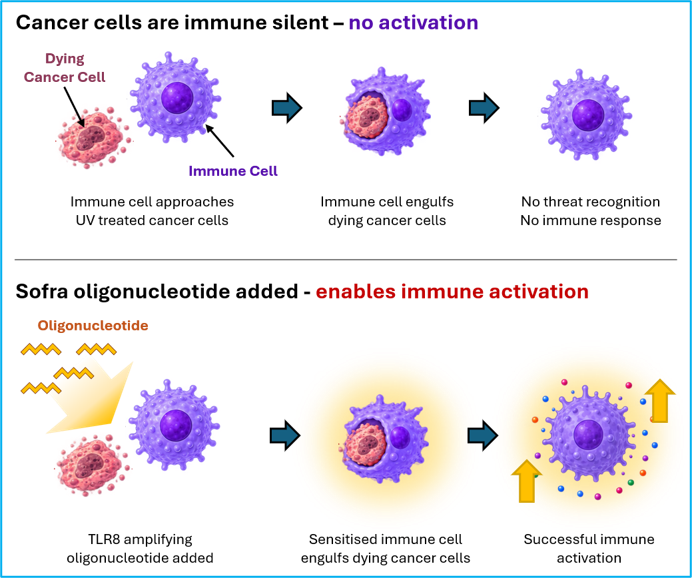
Dying cancer cells alone did not trigger immune activation. However, when combined with Noxopharm’s TLR8-amplifying oligonucleotide, the treatment elicited a significant immune response.
Figure 2 – A Sofra™ oligonucleotide enables TLR8-driven immune activation in cancer cell-engulfing immune cells ex vivo
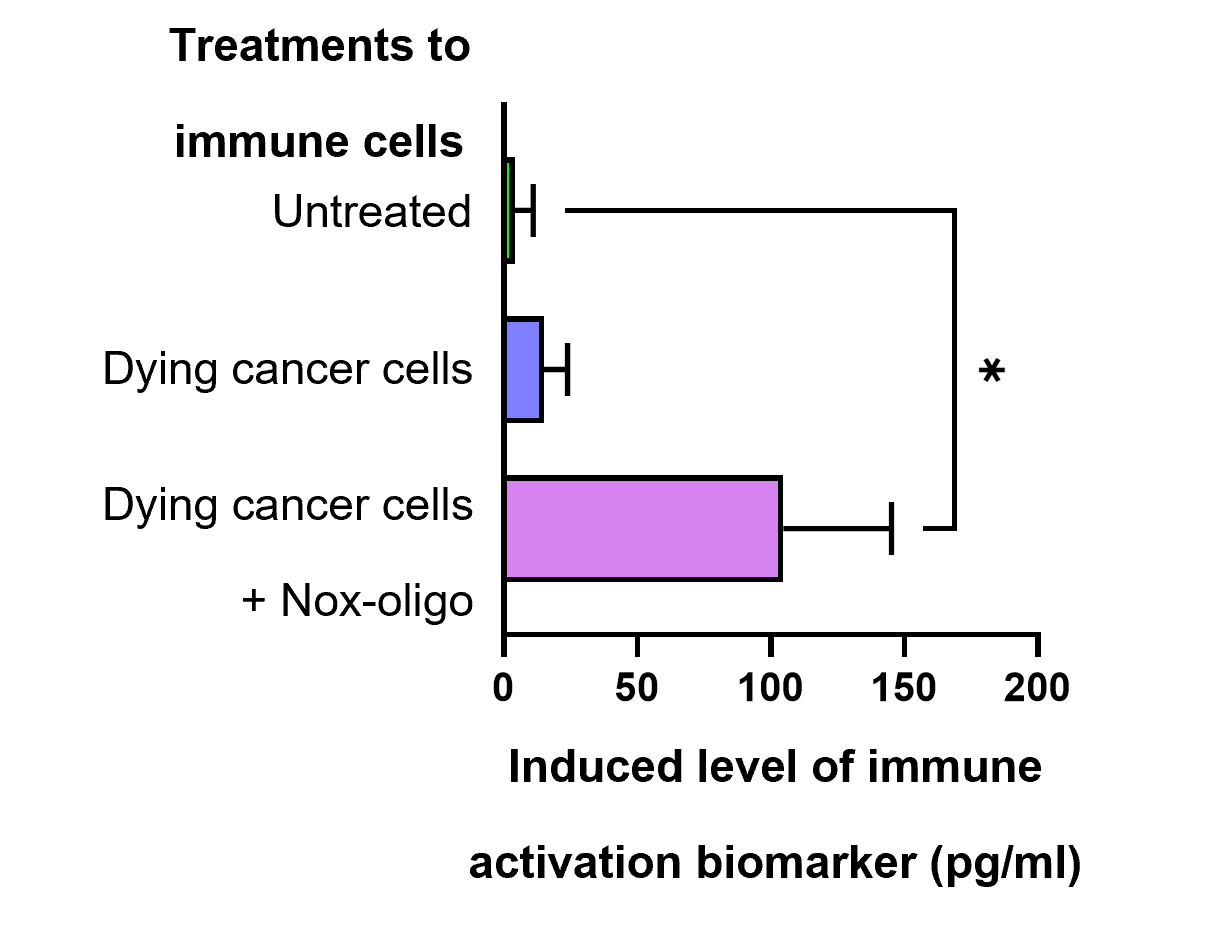
Immune cells called macrophages, which naturally engulf and clear dying cells, were derived from the bone marrow of mice carrying human TLR8. Lab-grown human cervical cancer cells, known as HeLa cells, were exposed to UV light to induce cell death. The dying cancer cells were then fed to the macrophages, but this alone did not trigger an immune activation. Treatment with 1 µM of a TLR8-amplifying oligonucleotide elicited a strong immune response when combined with dying cancer cells, reaching 7-fold the level of the untreated group.
Induced level of immune activation biomarker: The level of a TLR8-driven immune activation biomarker was measured, and the baseline level in the untreated group was subtracted to indicate the treatment-induced increase. Dying cancer cells: Cancer cells that had been exposed to UV light to induce cell death; Nox-oligo: a TLR8-amplifying oligonucleotide. Data graphed as Mean ± SEM (Standard Error of Mean); * p<0.05 by One-way ANOVA followed by Dunnett’s test.